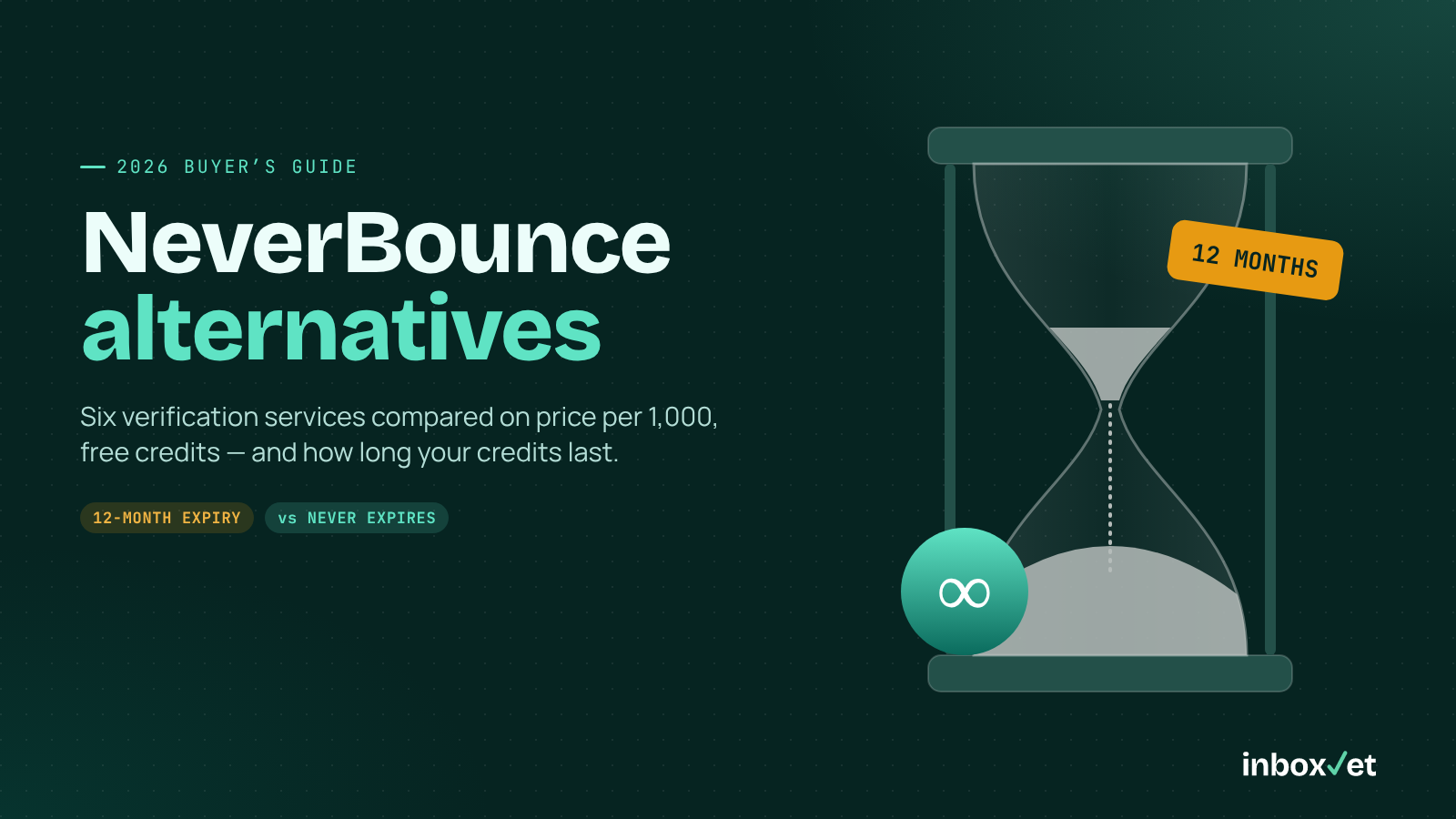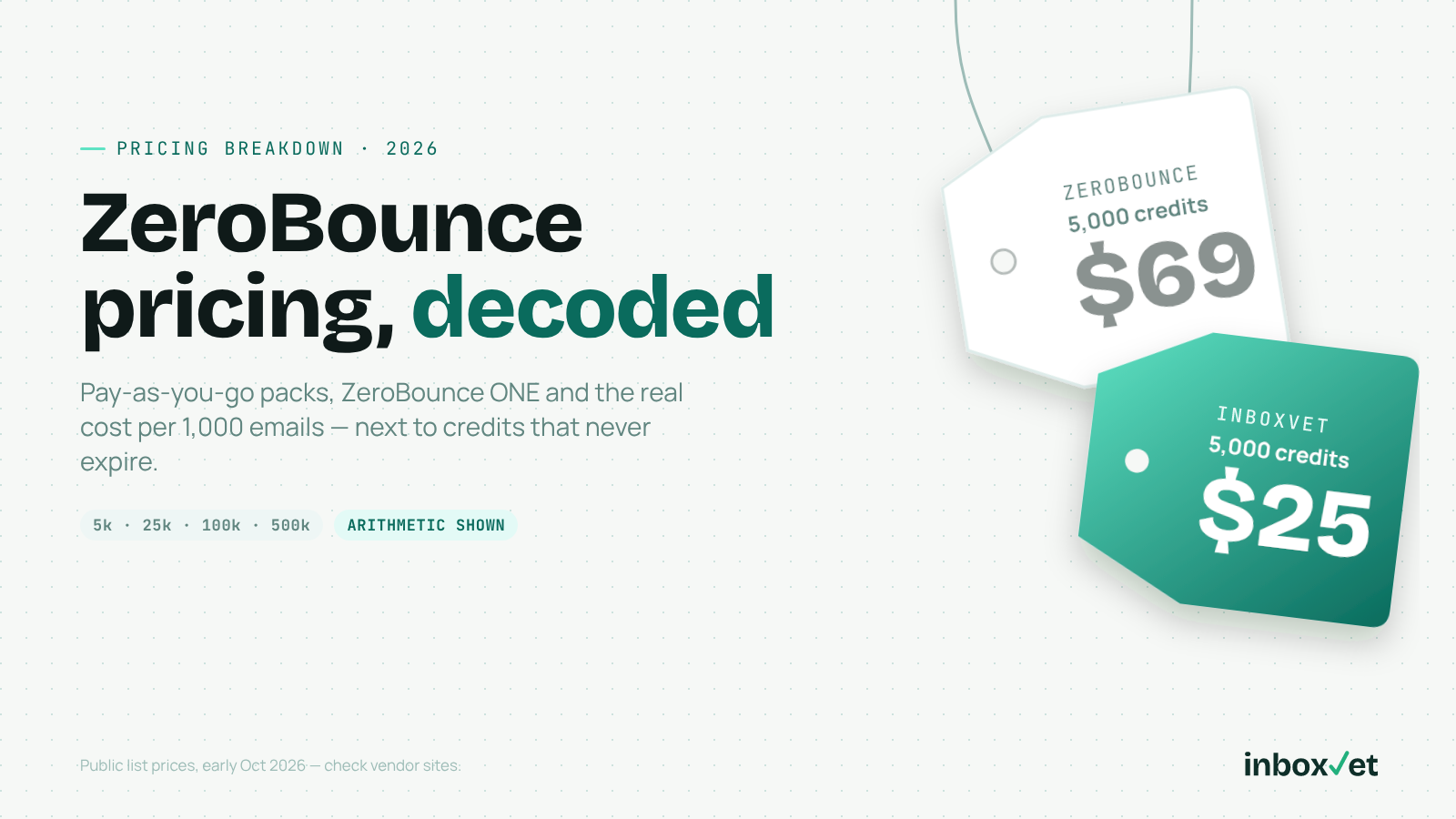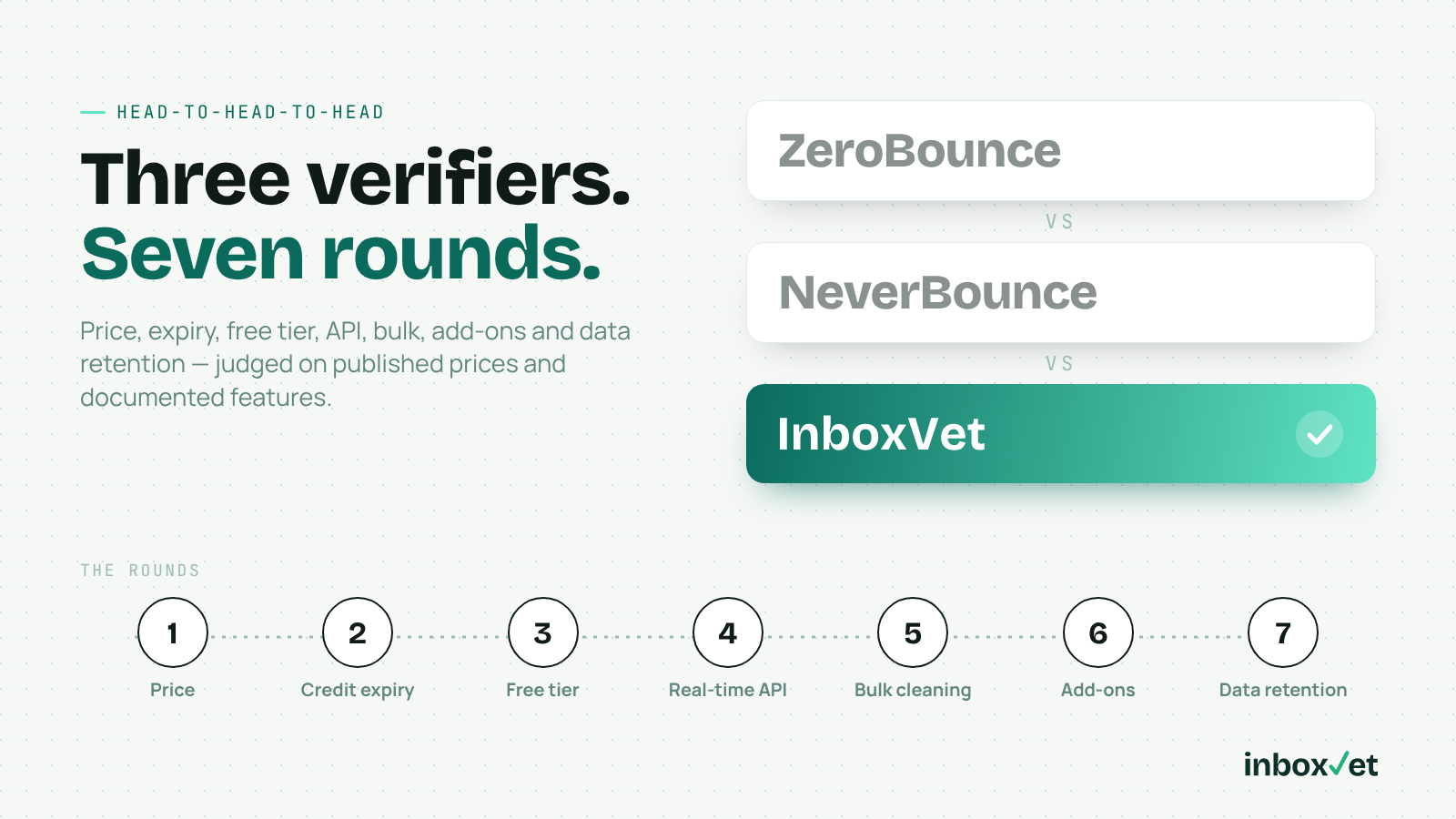
ZeroBounce vs NeverBounce is one of the most common comparisons people search before buying email verification. Both are established services, and both will clean a list well. The real differences show up in how you pay, how long your credits last and what comes bundled with verification. In this post we put the two side by side and add a third option, InboxVet, across seven rounds.
Full disclosure: this is the InboxVet blog. We have stuck to published prices and documented features, and where ZeroBounce or NeverBounce is the better pick, we say so in the verdict.
$0.60 per 1,000 verifications is InboxVet's lowest rate, on the $300 Enterprise pack of 500,000 credits.
Pricing note: Competitor prices checked from public pricing pages in early October 2026 — confirm on the vendor's site before buying.
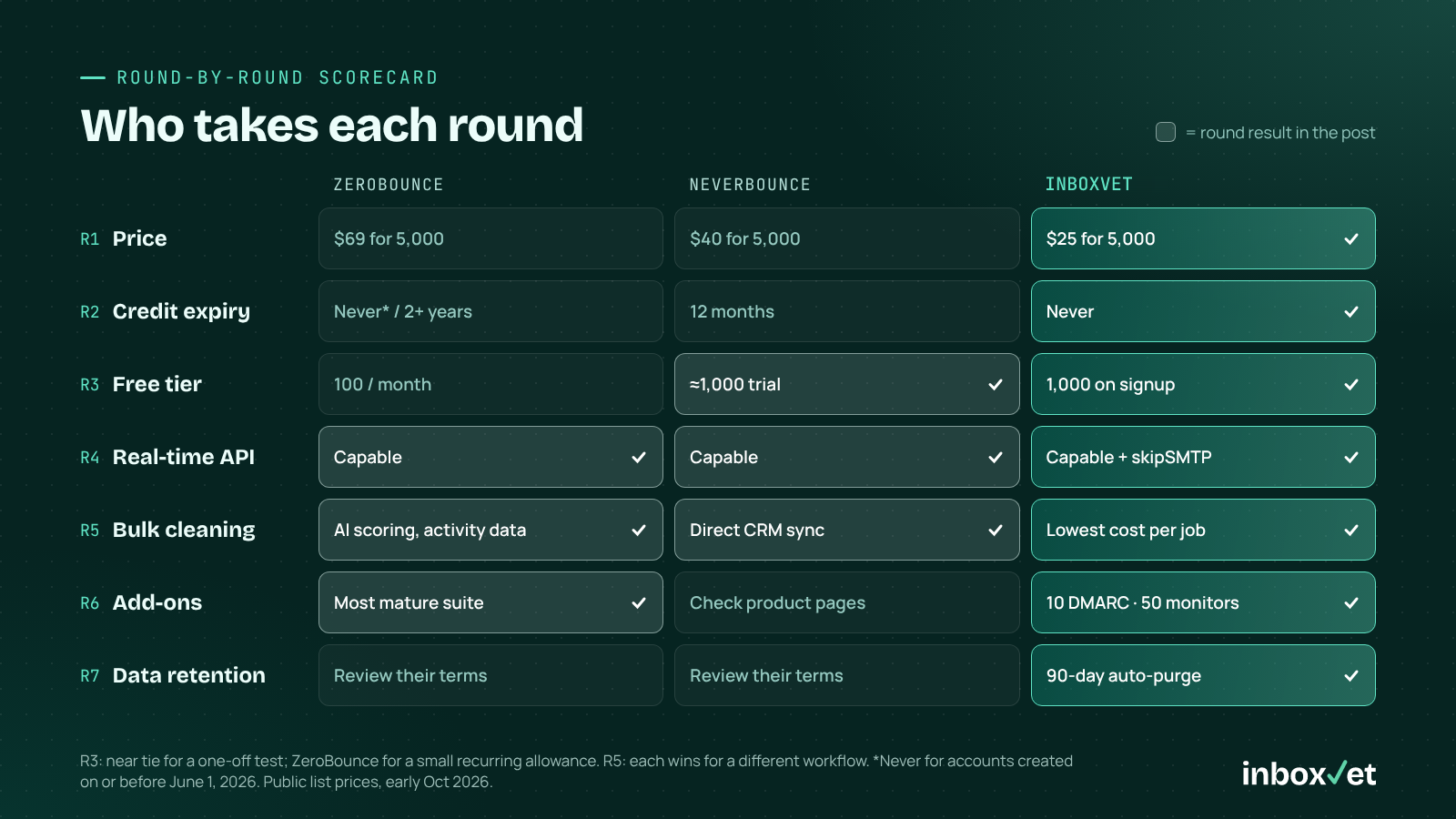
Figure: Round-by-round scorecard. Ticks mark each round's result as stated in this post, from price and credit expiry to add-ons and data retention.
ZeroBounce vs NeverBounce vs InboxVet at a Glance
If you only have a minute, this table is the summary. Each row is expanded in the rounds below.
| Category | ZeroBounce | NeverBounce | InboxVet |
|---|---|---|---|
| Pricing model | Pay-as-you-go packs + ZeroBounce ONE subscription | Pay-as-you-go + Growth plan | One-time credit packs; optional monthly bundles |
| Smallest purchase | 2,000 credits for $39 | $8 per 1,000 | 5,000 credits for $25 |
| Credit expiry | Never (accounts on or before June 1, 2026); 2+ years for newer accounts | 12 months after purchase | Never |
| Free credits | 100 per month | ≈ 1,000 (trial) | 100 on signup |
| Known strengths | Full deliverability suite, AI scoring, activity data | CRM sync (Salesforce, HubSpot, Marketo), 80+ integrations | Non-expiring credits, sub-100ms average response, skipSMTP toggle |
Round 1: Price at Three Volumes
Price is where the ZeroBounce vs NeverBounce gap is easiest to measure. We priced 5,000, 10,000 and 100,000 verifications using the cheapest published way to cover each volume. Cost per 1,000 is price divided by thousands of emails.
| Volume | ZeroBounce | NeverBounce | InboxVet |
|---|---|---|---|
| 5,000 | $69 ($13.80 / 1k) | 5 × $8 = $40 ($8.00 / 1k) | Starter $25 ($5.00 / 1k) |
| 10,000 | $129 ($12.90 / 1k) | $80 pay-as-you-go, or Growth plan $49/mo ($4.90 / 1k) | 2 × Starter = $50 ($5.00 / 1k), or Complete $39/mo ($3.90 / 1k) |
| 100,000 | $649 ($6.49 / 1k) | Volume tier below $8 / 1k — use their calculator | Scale $125 for 125,000 ($1.25 per 1k used) |
A few things stand out. At 5,000 emails NeverBounce is cheaper than ZeroBounce ($40 vs $69). At 10,000 a month, NeverBounce's Growth plan ($49) and InboxVet's Complete bundle ($39) both beat buying packs, as long as you use the credits every month. At 100,000, ZeroBounce's pack is $649 while InboxVet's Scale pack covers it for $125 with 25,000 credits left over.
NeverBounce's volume tiers drop to about $0.002 per email at very high volume, so check its pricing calculator for your exact number. ZeroBounce's tiers are on its pricing page; we break them down further in our ZeroBounce alternatives roundup.
Round 1 result: InboxVet is cheapest at 5k and 100k; at 10k/month the subscriptions are close.
Round 2: Credit Expiry
Expiry decides whether a bulk discount is actually a discount. If you buy 100,000 credits to get a lower rate and use only 60,000 before they lapse, your real cost per email goes up.
· ZeroBounce: credits never expire for accounts created on or before June 1, 2026. Newer accounts' purchased credits are valid at least two years. Check current terms.
· NeverBounce: pay-as-you-go credits expire 12 months after purchase.
· InboxVet: credits never expire. No subscription, no auto-renew, no auto-charge when you run out.
Round 2 result: InboxVet, with ZeroBounce close behind for older accounts. NeverBounce's 12-month window suits teams with steady monthly volume.
Round 3: Free Tier
ZeroBounce gives 100 free credits a month on a free account — useful for ongoing spot checks. NeverBounce offers a free trial of roughly 1,000 verifications. InboxVet gives 100 free credits on signup, plus free tools that don't use credits: an email verifier, an email server test and a blacklist check.
Round 3 result: a near tie between NeverBounce and InboxVet for a one-off test; ZeroBounce for a small recurring allowance.
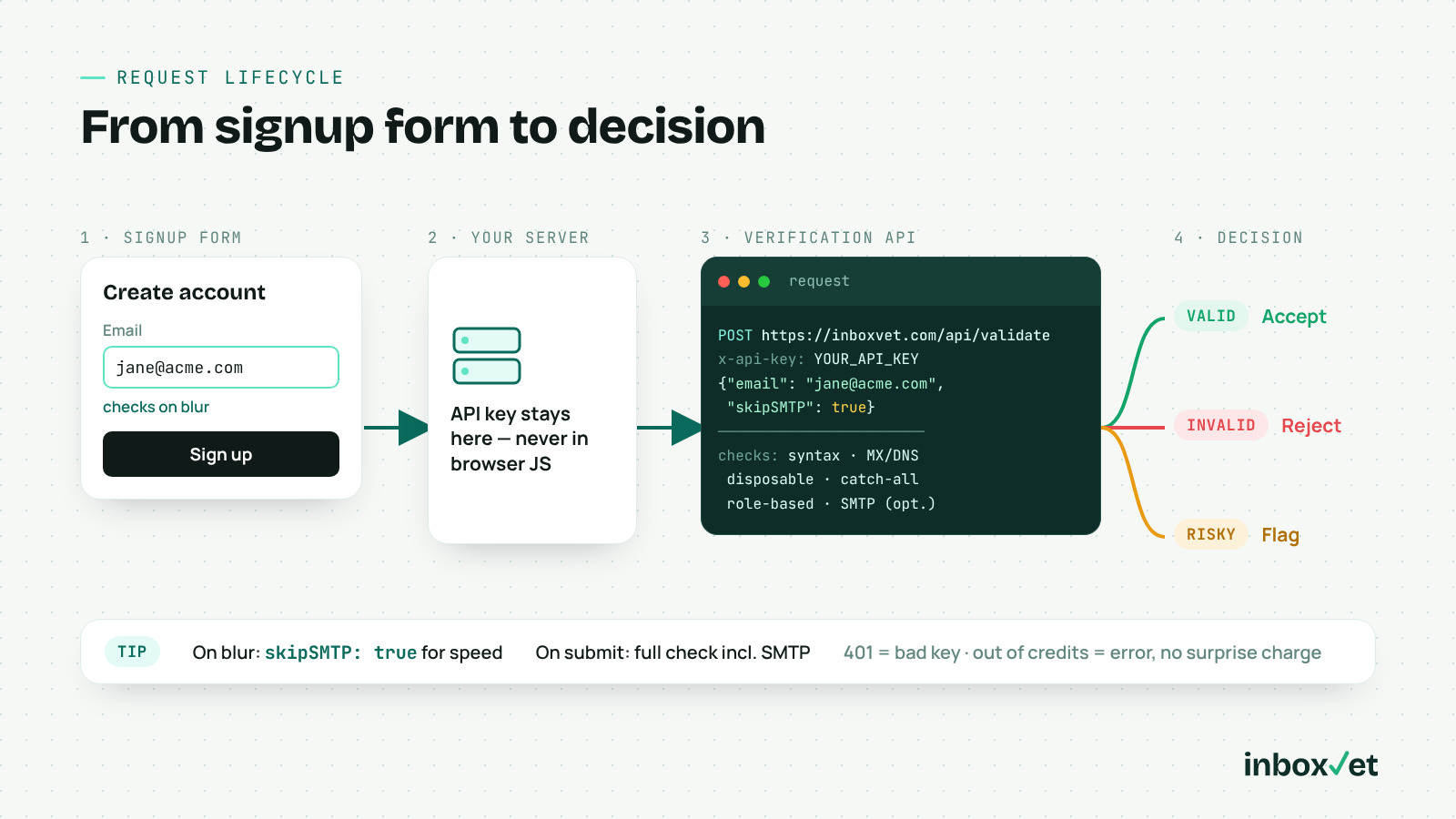
Figure: The request lifecycle: the signup form posts to your server, your server calls the verification API, and VALID, INVALID or RISKY maps to accept, reject or flag.
Round 4: Real-Time API
All three offer REST APIs authenticated with an API key, so any of them can verify addresses at signup. The differences are in speed, response shape and billing.
InboxVet reports 99.6% accuracy with a sub-100ms average response. One request runs syntax (RFC 5322, including Unicode domains), MX/DNS, disposable detection, catch-all detection, role-based flagging and, optionally, an SMTP mailbox check. Setting skipSMTP to true trades the mailbox check for speed, which is handy for checks as the user types.
curl -X POST https://inboxvet.com/api/validate \
  -H "Content-Type: application/json" \
  -H "x-api-key: YOUR_API_KEY" \
  -d '{"email":"user@example.com","skipSMTP":true}'

# Response
{"success": true,
 "result": {"email": "user@example.com", "status": "VALID",
            "syntaxValid": true, "isDisposable": false,
            "mxRecordExists": true, "isCatchAll": false,
            "smtpValid": null, "reason": "Email is valid"},
 "creditsRemaining": 99}
smtpValid is null here because SMTP was skipped. A missing or bad key returns 401; running out of credits returns an insufficient-credits error rather than a surprise charge.
💡 Developer Tip: Call the API from your server, never from browser JavaScript, so your key stays private. Run a fast skipSMTP: true check on blur and a full check on submit. More patterns are in our developer's guide to email validation APIs and the API docs.
Round 4 result: all three are capable. InboxVet gives you the most explicit control over the speed-versus-depth trade-off.
Round 5: Bulk List Cleaning
All three let you upload a list and download cleaned results. InboxVet supports CSV upload in the dashboard and a batch API endpoint that accepts up to 1,000 emails per request, at one credit per email. NeverBounce's strength here is syncing directly with CRMs such as Salesforce, HubSpot and Marketo, which saves an export-import step. ZeroBounce pairs bulk results with AI scoring and activity data, which helps when you are deciding what to do with uncertain addresses.
Round 5 result: NeverBounce if your list lives in a CRM; ZeroBounce for extra signals; InboxVet for the lowest cost per bulk job of the three.
Round 6: Deliverability Add-Ons
Verification fixes bad addresses. It doesn't fix authentication or blacklisting, which is why some teams want both in one place.
· ZeroBounce ONE: from $99/mo ($79/mo billed annually) with 10,000 credits plus deliverability tools. InboxVet's own pricing page (Sept 2026) notes ONE includes 1 DMARC domain and 10 blacklist monitors.
· NeverBounce: its offering centers on verification and integrations. If you need monitoring, check its current product pages.
· InboxVet: deliverability plans from Free to $79/mo, plus the Complete bundle at $39/mo with 10,000 credits a month, 10 DMARC domains, 50 blacklist monitors, 12-month history, API access, and webhook and Slack alerts.
This matters more since Gmail and Yahoo's February 2024 rules: bulk senders (5,000+ messages a day to Gmail) need SPF, DKIM and DMARC with alignment, one-click unsubscribe for marketing mail, and a user-reported spam rate below 0.10% that never reaches 0.30%. Microsoft began enforcing similar requirements for high-volume Outlook.com senders in 2025.
Round 6 result: ZeroBounce for the most mature suite; InboxVet for more monitored domains per dollar.
Round 7: Data Retention
InboxVet encrypts results at rest, auto-purges email addresses after 90 days, and never sells or shares data. For ZeroBounce and NeverBounce, review their data-processing terms directly — retention policies change and depend on your contract.
Round 7 result: InboxVet is the only one of the three whose retention period we can state here; verify the others yourself.
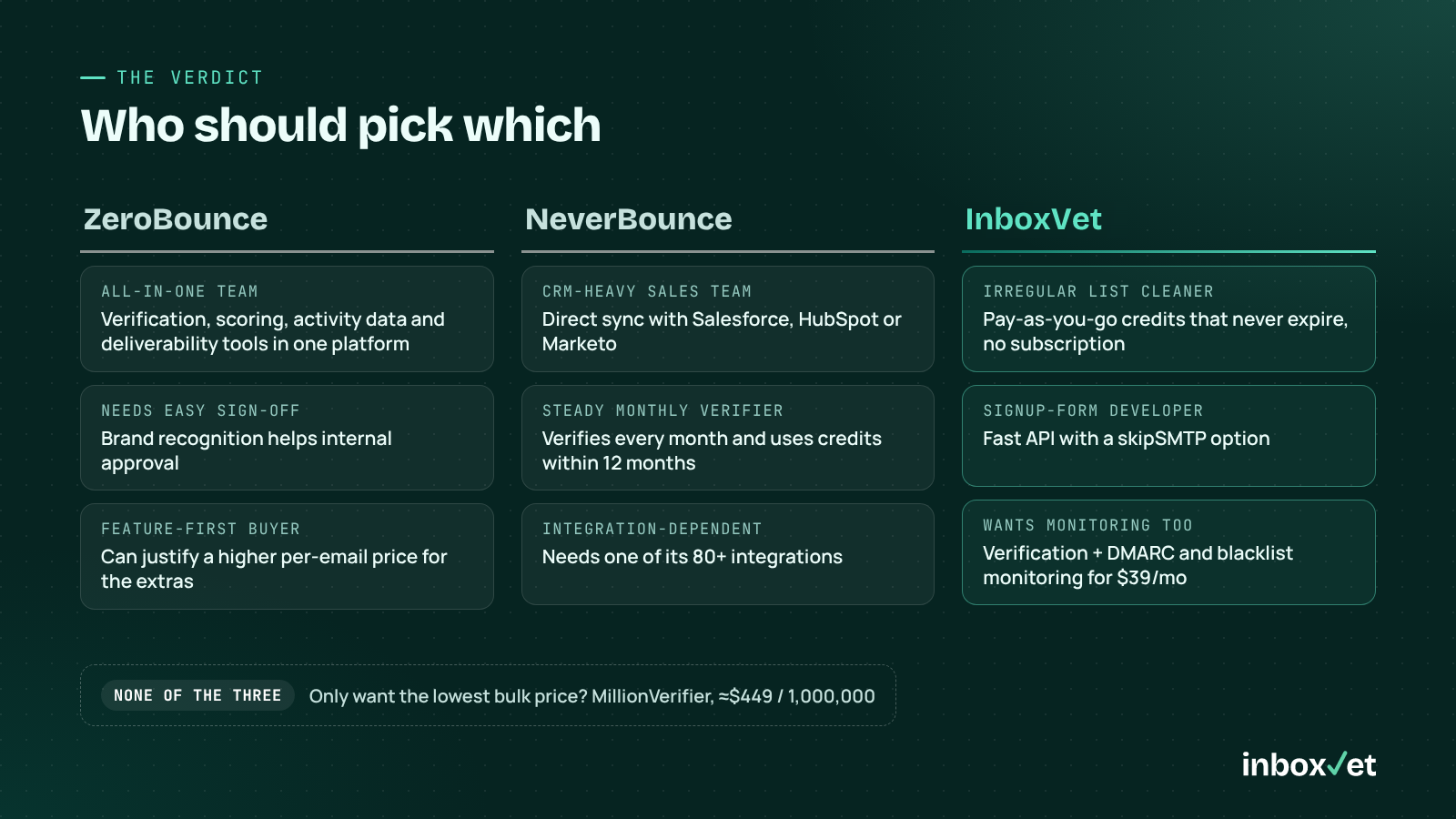
Figure: Who should pick which, based on the verdict: buyer types matched to ZeroBounce, NeverBounce or InboxVet, with MillionVerifier for the lowest bulk price.
The Verdict: ZeroBounce vs NeverBounce vs InboxVet
Pick ZeroBounce if…
· you want verification, scoring, activity data and deliverability tools in one mature platform;
· brand recognition helps internal approval;
· you can justify a higher per-email price for the extra features.
Pick NeverBounce if…
· your contacts live in Salesforce, HubSpot or Marketo and you want direct sync;
· you verify steadily each month and will use credits within 12 months;
· you need one of its 80+ integrations.
Pick InboxVet if…
· you want pay-as-you-go credits that never expire, with no subscription;
· you verify at signup and want a fast API with a skipSMTP option;
· you want verification plus DMARC and blacklist monitoring for $39/mo.
One more honest note: if your only goal is the lowest possible bulk price, none of these three wins. MillionVerifier is cheaper at very high volume, at about $449 per 1,000,000. See how all the main options compare in our email validation best practices guide.
Frequently Asked Questions (FAQ)
Q: Is ZeroBounce or NeverBounce better?
A: Neither is better for everyone. In a ZeroBounce vs NeverBounce choice, ZeroBounce offers a wider deliverability suite and longer-lasting credits, while NeverBounce is cheaper at small volumes and stronger on CRM sync.
Q: Which is cheaper, ZeroBounce or NeverBounce?
A: At the published pay-as-you-go rates, NeverBounce: 5,000 emails cost $40 versus $69 on ZeroBounce. Remember NeverBounce credits expire after 12 months.
Q: How does InboxVet compare on price?
A: InboxVet is $25 for 5,000 and $125 for 125,000, with credits that never expire — lower than both at the volumes we checked.
Q: Do all three check SMTP and catch-all domains?
A: All three perform mailbox-level checks and flag catch-all domains. InboxVet also lets you skip the SMTP step per request with skipSMTP.
Q: What bounce rate should I aim for after cleaning?
A: Under 2% is healthy; aim for under 1%. Lists decay steadily — commonly estimated at around 20–25% a year — so re-verify regularly. Our guide to reducing email bounce rate has more.
Q: Can I test InboxVet without paying?
A: Yes. Sign up for 100 free credits, then compare packs on the pricing page.
Making the Final Call
The ZeroBounce vs NeverBounce question usually comes down to features versus integrations. Adding InboxVet to the shortlist brings a third trade-off: lower prices and credits that never expire, in exchange for a smaller brand. Run the same sample list through each service's free credits, compare how they label risky addresses, and choose based on your volume and workflow.
Try InboxVet Free — compare it on your own list at inboxvet.com